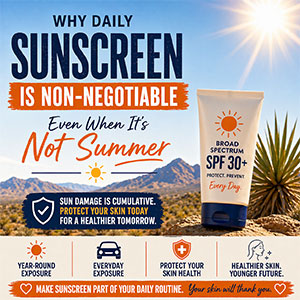
In Southern New Mexico, the sun isn’t a seasonal guest. It’s a permanent resident.
Clear skies, high elevation, and intense UV levels mean your skin is exposed almost every day of the year—not just during summer. Around here, sunscreen isn’t optional. It’s foundational.
Living in the desert changes the equation.
Several regional factors make UV exposure more intense in our area:
- Higher elevation increases UV radiation (you’re literally closer to the sun)
- Clear, dry air allows more UV rays to reach your skin
- Minimal cloud cover means fewer natural barriers
- Sunlight reflects off sand, concrete, and light-colored surfaces, increasing exposure
Even when temperatures feel mild, the UV index in Southern New Mexico is often high to extreme.
In other words, this isn’t “summer sun.” It’s year-round sun with fewer filters.
One of the biggest misconceptions is that if it doesn’t feel hot, it’s not doing damage.
But UV exposure works quietly:
- You can develop damage without ever burning
- You may not notice anything until years later
- Daily exposure accumulates even during routine activities
In this climate, it’s easy to underestimate how much your skin is actually absorbing.
There are two main types of UV rays that affect your skin:
- UVB rays cause sunburn
- UVA rays penetrate deeper and are present every day of the year
UVA rays are the ones responsible for:
- Premature aging
- Loss of elasticity
- Sunspots and uneven tone
- Long-term skin damage
And importantly, they pass through windows—so even driving around Alamogordo or sitting near a window counts as exposure.
You don’t need to be hiking or at the lake to be at risk.In Southern New Mexico, exposure happens during:
- Driving (especially long, sun-filled commutes)
- Running errands
- Working outdoors, even briefly
- Sitting near windows at home or work
Because our environment is so consistently bright, these small exposures happen every single day.
Sun damage is cumulative everywhere—but in the Southwest, it adds up faster.
That’s why many people notice:
- Earlier onset of fine lines and wrinkles
- More pronounced sunspots
- Rougher skin texture over time
It’s not just aging—it’s accelerated photoaging from consistent UV exposure.
Skin Cancer Risk Is Higher With Consistent Exposure
UV exposure is the leading cause of skin cancer, and the risk is tied to lifetime accumulation.
In high-UV regions like Southern New Mexico:
- Even “normal” daily exposure can contribute to risk
- Damage often occurs without obvious warning signs
- Prevention plays a critical role in long-term skin health
Daily sunscreen use is one of the most effective ways to reduce that risk.
In this environment, sunscreen should be as routine as brushing your teeth.
For best protection:
- Choose a broad-spectrum sunscreen (UVA + UVB protection)
- Use SPF 30 or higher
- Apply it every morning, regardless of weather
- Reapply if you’re spending extended time outdoors
Look for formulas that are lightweight and comfortable—many modern options are designed for daily wear without feeling heavy or greasy.
In Southern New Mexico, the sun isn’t occasional—it’s constant.
You don’t need a beach day to justify sunscreen. You just need to step outside… or even sit by a window.
Daily sunscreen use isn’t about being cautious—it’s about being realistic about where you live.